Four years at Eclipse Foundation: Looking Back
- Career
It’s hard to believe it’s already been four years since I started my career as a web developer. Every one of those years was spent at the Eclipse Foundation, where I had the opportunity to grow both professionally and personally. From collaborating with the Eclipse community to building and maintaining our Hugo theme, PHP theme, CSS library, and web component library, I worked on the foundation that powers 20+ websites. The work was always varied, sometimes demanding, but consistently rewarding - and I enjoyed every minute of it.
The first year
When I first joined, I was completely new to the industry. At the time, I was much more of a follower than a technical leader. Most of my work involved navigating an existing codebase rather than designing new systems, and that codebase was largely built on legacy PHP 5, ES5 JavaScript, and plenty of jQuery. It wasn’t the modern stack I had been exposed to in school or through my personal projects, and learning to work effectively within an established system was a challenge in itself.
Like any junior developer, I made my fair share of mistakes. Some refactors turned out to be far more disruptive than I anticipated, including removing features that members of the Eclipse community depended on (oops). Those experiences taught me the importance of understanding existing systems, respecting backwards compatibility, and recognizing the impact that even seemingly small changes can have on real users.
That experience has stayed with me. It fundamentally changed how I approach changes to public-facing software and made me much more disciplined about semantic versioning, backwards compatibility, and carefully considering the impact of every release.
Later that year, I was given the opportunity to implement a major website redesign. Looking back, I made several architectural decisions that I would approach differently today. As the project evolved, some of those early choices became increasingly costly to maintain. It was a humbling experience, but one that shaped how I think about software architecture, technical debt, and the importance of making decisions that can scale beyond the immediate needs of a project.
The middle years
In the middle years, I became more comfortable making technical decisions and helping steer projects in a particular direction. I began taking ownership of several libraries and websites, and even spearheaded major refactors, including the Foundation’s Membership Portal.
The Membership Portal is the Foundation’s dashboard application that allows
members to view their project activity and manage their relationship with the
Foundation. To put it lightly, the application had significant performance
challenges. The refactor replaced a convoluted collection of useEffect-driven
logic with Redux Toolkit, eliminating unnecessary re-renders from the
application and significantly simplifying the overall codebase.
During this period, we also adopted TypeScript across our libraries, introduced unit testing, and invested in better developer and user documentation through Storybook. These years were about taking the lessons I had learned early on and applying them, moving from simply contributing to projects toward actively shaping their technical direction.
The final year
An unexpected brand refresh came into my lap, and I had to move quickly. There simply was not enough time to completely rethink the architecture, so, reluctantly, we repeated some of the same mistakes from previous redesigns. However, as time went on, we continued working behind the scenes to gradually turn that refresh into something more mature and maintainable.
I’ll admit it: this was one of the most challenging projects I worked on, and I never quite felt like I fully solved it. We were dealing with a legacy CSS and component library that had been around for more than 14 years. It was deeply coupled to nearly every website operated by the Foundation, making any significant change a difficult balancing act.
Despite those challenges, we made significant progress. Rather than continuing to evolve the legacy system, Solstice Assets, indefinitely, we began breaking it apart into three distinct initiatives:
- A new CSS theme: lightweight, preferably built with vanilla CSS, and easier for projects to adopt independently.
- A JavaScript API client: something that could eventually be offered as a service to the community, allowing developers to build their own experiences without needing to understand or maintain API schemas.
- A component library: Solstice Components, which was the only one of these initiatives to reach completion.
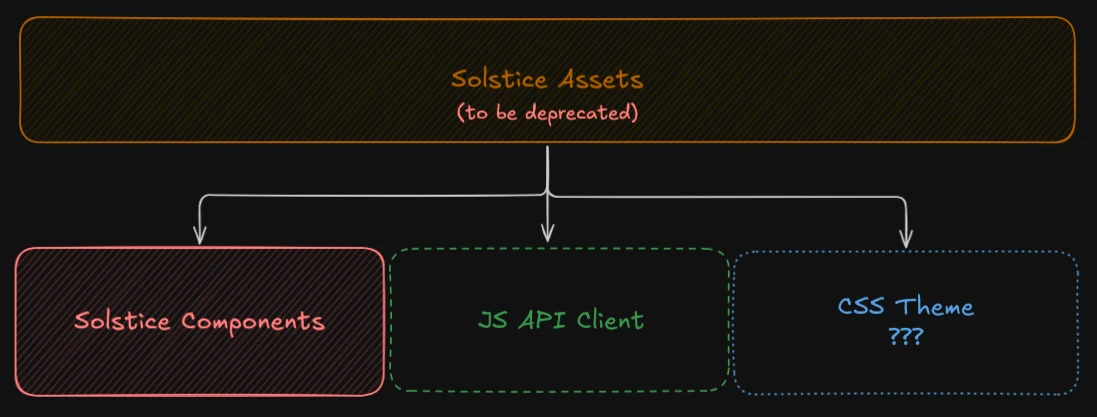
A diagram showcasing how Solstice Assets (deprecated) can be broken into Solstice Components, a JS API client, and a CSS theme.
Solstice Components became a modern, framework-agnostic component library built with web components and Lit, allowing these components to be used across websites regardless of their underlying technology stack. See my post about it here .
We also took the opportunity to properly deprecate major portions of the Hugo theme. We moved from a messy 0.x.x version history that contained three separate brand refreshes in the same major version to proper semantic versioning, releasing 1.0.0, 2.0.0, and 3.0.0. This allowed us to better communicate breaking changes, reduce maintenance complexity, and avoid carrying years of accumulated technical debt forward.
If only I had more time to do the same with Solstice Assets. It remains one of the biggest pieces of unfinished work, and I hope the next person who takes ownership of it can see it through. The foundation has been laid, the problems are better understood, and I believe it is now in a much better position to be transformed into something more modern and maintainable.
Conclusion
Looking back, my time at Eclipse Foundation has been a journey of growth. I joined as someone still learning how to navigate a large and unfamiliar codebase, and I leave having had the opportunity to shape the architecture, tools, and practices that support the Foundation’s work.
Not every challenge was solved perfectly. Some things remain unfinished, and some decisions were made under constraints that required compromise. But I am proud of the progress we made, the foundations we built, and the people I had the opportunity to work alongside.
The biggest lesson I am taking away is that engineering is rarely about creating something perfect from the beginning. It is about continuously improving, making thoughtful decisions, and leaving systems in a better state for the people who come after you.
Thank you to everyone at Eclipse Foundation who trusted me, challenged me, and helped me grow over these past four years. It has been an incredible chapter of my career, and I am excited to see what comes next.

Olivier Goulet
Software developer